The Modern Art & Design Sale Presents – Yves Klein
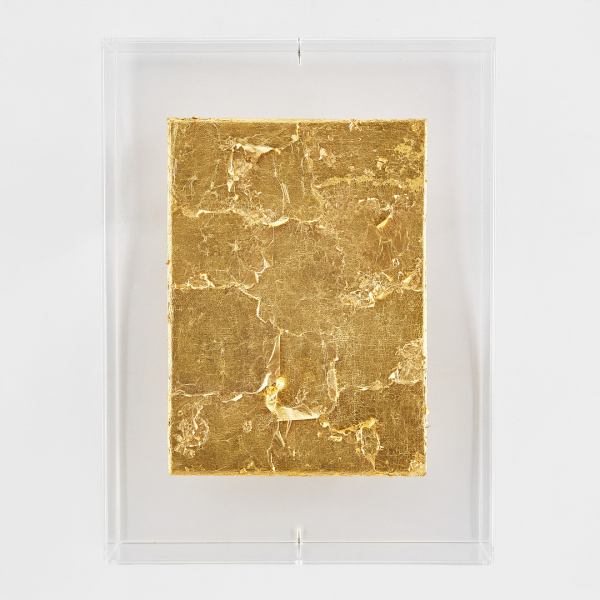
Yves Klein (France 1928-1962) “Âge d’or [Golden Age], (MG 36)”
Gold leaf on canvas mounted on panel, 22 x 16 cm, including frame 35 x 28 x 6 cm. Signed and dated with a red pen “age d’or” monogold 1959 — Yves Klein on the reverse, also signed and dated Yves 59 on the overlap.
ESTIMATE 13 000 000–15 000 000 SEK
Stockholms Auktionsverk presents “Âge d’or [Golden Age], (MG 36)” (1959) by Yves Klein at this autumn’s auction The Modern Art & Design Sale
Despite a brief artistic career, cut dramatically short by several heart attacks at the age of 34 and his sudden death in June 1962, Klein became a pioneering figure in post-war European art, and is widely considered among the leading developers of performance art, as well as an important forerunner of minimal art and also the Pop Art movement. He never received formal artistic training, though he had a well-rounded creative upbringing from his parents, both of whom were painters; his father was a figurative, post-Impressionist style artist and his mother had an interest in abstract art and was a central figure in the Art Informel movement.
Born and raised in Nice, France, Klein studied at the École Nationale de la Marine Marchande and the École Nationale des Langues Orientales (1942-1946). His principal pursuits following his educational years were in the fields of judo and music. From 1948 to 1952 he traveled to judo training and competitions in Italy, Great Britain, Spain, and Japan, where, at the age of 25, he became a fourth-degree black belt, the first European to rise to such distinction. His interest in music–he was a close friend of the the French composer Claude Pascal (1921-2017) since his school years–found expression in his “Monotone Symphony”, conceived between 1947 and 1948 (formally titled “Monotone Silence Symphony”, 1949). The futuristic, avant-garde composition, the first public performance of which occurred in a Paris art gallery in 1960, consists of a single 20-minute sustained D major chord followed by a 20-minute silence, and presents a musical precedent to his later monochrome paintings.
By 1955, Klein had settled in Paris and focused on an artistic career, notably as a painter of the monochrome works which would transform his reputation internationally. Although he had painted monochromatic works as early as 1949 and exhibited publicly in 1950, the paintings garnered widespread recognition with several groundbreaking exhibitions during the mid-1950s. Among the first of these gallery shows, one of his oil paintings at the Club des Solitaires, Paris, October 1955, and another “Yves: Proposition Monochromes” at Gallery Colette Allendy, Paris, February 1956, Klein presented a series of monochromatic paintings in various colors including orange, yellow, red, pink, and blue. Despite critical attention for these early exhibitions, Klein was disappointed by the public reaction to the monochrome paintings as mere decorative works.
He planned a subsequent exhibition, “Proposte Monocrome, Epoca Blu” (Proposition Monochrome; Blue Epoch) at the Gallery Apollinaire, Milan, January 1957, which featured eleven identical blue canvases. He had painted each of the canvases uniformly using an ultramarine, or vivid blue pigment, suspended in a synthetic resin Rhodopas (a particular brand of common wood glue marketed by a French pharmaceutical company at the time), rather than the more commonly used linseed oil. Klein described the color as “The Medium”; it was reminiscent of the lapis lazuli pigment used to enhance and glorify celebrated figures in Medieval and Renaissance paintings. For the Gallery Apollinaire, Milan, exhibition, each of the identical blue paintings was priced differently, buyers would proceed through the gallery and select a painting to purchase based on their own visual impact. The show was a major critical and commercial success, and traveled to Paris, Düsseldorf, and London.
The particular shade of blue that he used (registered by the artist as “International Klein Blue” or “IKB” in 1960 with the Institut National de la Propriété Industrielle, Paris), would become a predominant basis of his fame and success. It was meant to evoke the immaterial and boundless nature of the self and the world as understood by Klein via his interest in different schools of philosophical and spiritual thought, Zen Buddhism in particular, that had been a continued interest to him since his school years. Alongside the metaphysical tenets that Klein brought to his artistic work, from the outset of his career, he was also a talented and intuitive promoter of his art, ahead of his time with his approach to artistic publicity and hype. To mark the May 1957 opening of the IKB monochrome paintings at the Iris Clert Gallery, Paris, 1,001 blue balloons were released into the Paris sky and Klein also mailed numerous announcement postcards using IKB stamps that he had bribed the postal service to accept as legitimate. These brash and new efforts of showmanship brought him greater attention publicly and wider observation critically.
Following the groundbreaking exhibitions of the monochrome blue paintings throughout Europe in 1957, Klein organized a series of equally audacious gallery shows over the next two years. For an exhibition called “La spécialisation de la sensibilité à l’état matière première en sensibilité picturale stabilisée, Le Vide” (The Specialization of Sensibility in the Raw Material State into Stabilized Pictorial Sensibility, The Void), at the Iris Clert Gallery, April 1958, he emptied the gallery space except for a large glass display cabinet and painted the walls and surfaces white. At the opening night of the show, Klein painted the gallery window blue and a blue curtain was hung in the entrance lobby, in homage to the blue monochrome paintings, through which a crowd of more than 3,000 attendees, encouraged by a significant publicity drive, flowed into a gallery devoid of art, with only an empty display case. In another exhibition at the Iris Clert Gallery, June 1959, “Bas-Reliefs dans une Forêt d’Éponges,” Klein showed a collection of blue sponges that he had used to paint IKB canvases, mounted on steel rods and set in ordinary rocks from a garden. Around 1960, Klein began of series of works he called “Anthropométries”, which were part painting and part performance art, for which he used nude women as human paintbrushes, applying blue paint to their bodies and putting them in contact with canvas, paper, gallery walls, and other materials, to create oversize, abstract compositions.
Klein also had a strong affinity for gold, traceable to 1949 when he worked briefly in the workshop of Robert Strange, the renowned London picture framer-gilder and friend of his artist father. He recollected later in his artistic career his fascination with gold dating back to his apprenticeship in London, in particular how the gold leaves would fly away with the slightest movement of air and how when applied over the plain base surface of a frame could produce a gleaming, extraordinary object. Like the unique color blue that he had produced, gold held a special spiritual quality for Klein. Through its inherent shine, reflection, and resistance to tarnish or corrosion, it offered the capability that Klein sought to transform an artwork from the “material” to the “immaterial”, from temporality to the immortal realm. Klein embraced gold as an ancient material long revered by myriad civilizations, with a widespread ability to mesmerize the beholder. His reverence of gold alongside the use of the vivid blue pigment he had created was far from chance, it linked his work with the practices of medieval and Renaissance artists, such as Fra Angelico (1395-1455) and Giotto (died 1337), who also boldly incorporated these colors in their religious panels. Like his Renaissance predecessors, Klein used gold more sparingly due in part to the sheer cost of the materials required to make them. Compared to the number of blue monochromes in his oeuvre, Klein’s gold monochromes are significantly more scarce.
“Âge d’or [Golden Age], (MG 36)”, the 1959 gold leaf on canvas mounted on panel work presented here, hails from the apex of Klein’s artistic career. It was executed during the first year that Klein began to create the monochromatic gold works. The glowing, textured surface of the gold covered canvas shimmers from different points of view, its luminosity varied by the uneven veneer and the play of light over its finish. The delicate nature of the materials, with some slivers of the gold leaf in relief, freed from the canvas surface, suggests the possibility of the elements quivering with the slightest breeze, even from the breath of a viewer. This important work encapsulates the scope of Klein’s artistic expression, his perception of gold as a symbol of purity and spirit, and his use of the medium to explore the concepts of the immaterial and transcendent.
In working with gold, Klein also managed to combine performance with the ethereal, much as he had with “Anthropométries” and IKB. For “Zone de Sensibilité Picturale Immatérielle” (Zone of Immaterial Pictorial Sensibility), conceived in 1959, the same year as the creation of “Âge d’or [Golden Age], (MG 36)”, Klein planned a performance that involved the sale of documentation of ownership of empty space (or the “Zone of Immaterial”), in the form of a paper receipt, in exchange for gold; if the buyer acquiesced, the piece could be completed in an elaborate outdoor ritual in which the buyer would burn the receipt, and Klein would throw half of the gold into the Seine. Additionally, the “Zone” ritual would be performed in the presence of an art critic or distinguished dealer, an art museum director and at least two witnesses, photographed and filmed. Between the creation of the piece in 1959 and his death in June 1962, eight “Zones” were sold, three of which involved the elaborate final ritual. The performance piece capped Klein’s brilliant creative profession.
However brief his fervently inventive artistic career, in the span of fewer than fifteen years he crossed many creative thresholds that would be considered unusual even for a vocation decades longer, Klein provided immeasurable contributions to the art world through his boundless experimentation and pioneering energy. Throughout this creative period, Klein remained steadfast to the leitmotifs of his craft, in particular his monochromatic paintings and performance art, which stemmed from deeply held philosophic beliefs, and with which he combined an uncanny ability to promote his work, as he sought to create a new kind of art that eschewed the ephemeral, material world, for spiritual connection instead.
The Work Is Being Sold at The Modern Art & Design Sale
Estimate: 13 000 000–15 000 000 SEK
Catalogue: November 5
Viewing: November 7–18
Auction: November 19–20
Inquiries & condition reports